The Direction Most Medical AI Is Heading
Ask any vendor pitching clinical AI in 2026, and the demo flow is roughly the same. Physician speaks into a microphone. AI transcribes. AI structures the conversation into SOAP. AI drafts orders, billing codes, a discharge summary. AI writes to the EHR. Physician leaves for lunch.
The value proposition is efficiency. The assumption is that once a model is "good enough," the physician can step out of the loop.
iRehab Doctor AI is technically capable of every step in that flow. We chose not to wire it that way — not because the technology isn't ready, but because physicians don't actually need what that flow delivers.
The Real Clinical Need: Intake Compression, Not Form Consolidation
Before a physician can document anything, they have to decode the patient sitting in front of them. A patient rarely walks in with a structured complaint. They arrive with a stream — pain here, numbness there, a medication they're not sure worked, something a family member mentioned, an unrelated worry about the other knee.
Every specialty has its own compressed schema for what actually matters. Orthopedics typically reduces to four fields: which site, how severe, trauma or degeneration, how long. Primary care collapses to chief complaint, onset, severity, red flags. Oncology runs on tumor type, stage, treatment history, current trajectory. The fields differ; the pattern is universal. Once those fields are populated, the diagnostic hypothesis assembles itself in the physician's head, and the next-step decision — imaging, injection, referral, reassurance — falls out almost automatically.
The first five minutes of a fifteen-minute consult are usually not clinical reasoning. They are translation — compressing the patient's stream into the four or five fields the specialty actually uses.
That translation step is what AI should take on. Not writing the discharge summary. Not producing the billing code. Two weeks of the patient's reported data — VAS trends, wound photos, exercise logs, PROM scores — compressed into a specialty-relevant summary in the two minutes before the patient sits down.
In iRehab, what lands on the physician's screen looks like:
POD 14, right knee. VAS 6 → 3. Family wound photo from three days ago — mild erythema. 70% of prescribed exercises completed yesterday.
Four fields. Read in five seconds. The diagnosis forms. The remaining ten minutes belong to the patient.
What iRehab Actually Built: Translator, Then Confirmer
iRehab Doctor AI is two layers stacked in a specific order.
The translator. Before the visit, the system compresses longitudinal patient-reported data — symptom diaries, VAS trends, wound photos, exercise completion, PROM scores — into a specialty-relevant summary. It does not consolidate forms. It consolidates context. The physician opens Doctor PWA and sees not a 37-field template but a four-field clinical picture, plus an AI-suggested SOAP draft built on top of it.
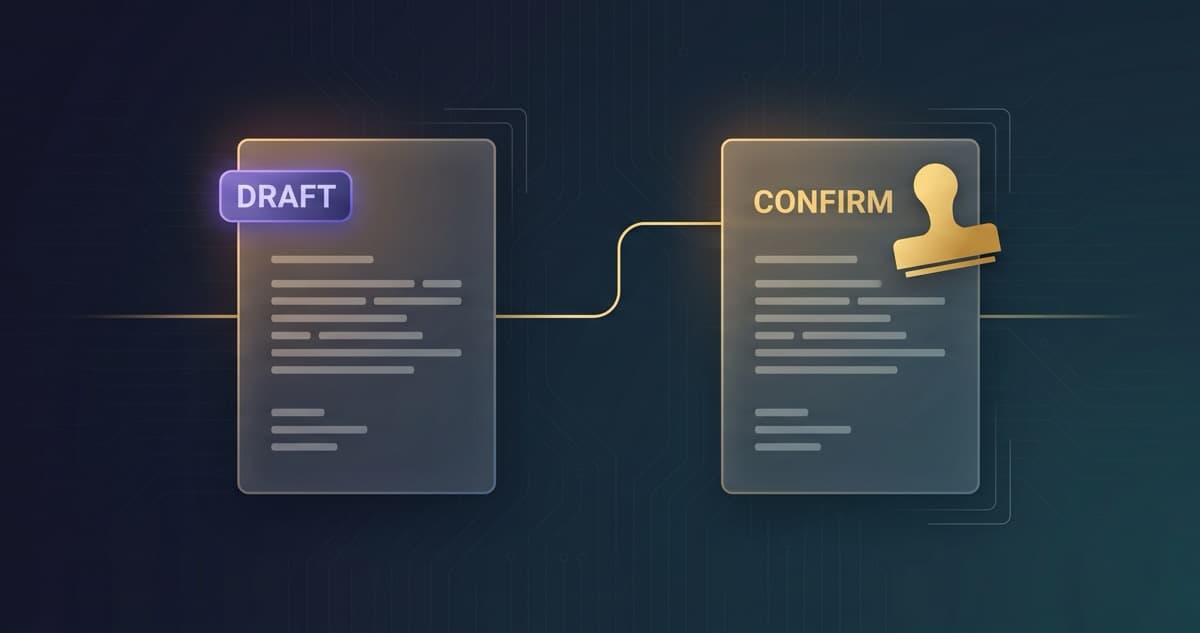
The confirmer. The physician reads the draft, edits what needs editing, confirms. Only that confirmation turns a draft into a record.
The translator is where the user value lives — five seconds of reading replaces five minutes of decoding a verbal stream. The confirmer is where the accountability lives. Both layers are load-bearing. Remove either one and the product stops making clinical sense.
The common industry reflex is to present these as a tradeoff: more automation versus more safety. We don't see it that way. The translator earns its place by handing the physician a better starting point. The confirmer earns its place by making sure the finishing point is still a human decision. Neither layer is friction for the other; they do different jobs.
Draft-Only Enforcement — The Guardrail on the Translator
Once the translator is this useful, a reasonable next question is: can AI skip the confirmation step entirely? Our answer is a hard no, and it is enforced at the product level by a rule we call Draft-Only Enforcement:
Any medical document produced by AI is marked as a draft. A draft never becomes part of the patient's official record until a licensed physician performs a manual confirmation.
Concretely:
- AI can generate assessments, prescriptions, surgical records, and billing — but cannot submit them.
- AI can populate fields, surface context, and offer the best starting point — but never pushes to the EHR on its own.
- A document cannot be saved in one step. Draft → Confirm is two actions, and they cannot be merged.
Technically, this is a trivial constraint. The difficulty is not the engineering. It is the discipline to leave the second step in place when every product instinct — and every quarter of model improvement — argues for removing it.
The moment Draft → Confirm collapses into a single action, the chain of clinical responsibility is severed. Not degraded — severed. And resilience in a clinical system lives entirely in the integrity of that chain.
There is a further principle behind the rule. If AI can fully replace a physician in writing charts, prescribing, and operating, that is not a triumph of technology. It is a signal that the medical profession, as a licensed and accountable craft, has ended. We do not believe the technology is there. We do not believe the ethics would survive if it were.
Three Misreadings of "Integration"
Physicians asking for "document integration" usually mean one of three things, and understanding why none of them is the right answer clarifies why the translator-plus-confirmer shape is.
Integration as automation. "Write everything for me and I will not touch it." The finished document carries the physician's name; the physician has not read it. The responsibility chain is nominally intact and practically broken.
Integration as a unified form. "Put every field on one screen so I don't have to click between tabs." Cerner and Epic have been doing this for thirty years. The field count grows. The typing time does not shrink. The real problem — cognitive load per encounter — is not a UI-layout problem.
Integration as "AI finished, therefore done." The deepest misreading. Medical documentation is not a deliverable. It is the evidentiary record of a clinical judgment. "Medial meniscal tear post-repair, consider MRI follow-up" is valuable because a named physician put their license behind it. If AI writes it and the physician signs without reading, the record is text without evidentiary weight.
What physicians actually need is not a merged form. It is five seconds to the point. Translator, then confirmer.
The Over-Generation Failure Mode
Watch enough clinical AI demos and a pattern emerges. The anxiety everyone voices is that the model "isn't accurate enough yet." The failure mode that actually shows up in deployment is the opposite: over-generation. Given a patient's fragmented utterance — three complaints, a family aside, a tangent about a different joint — the model pads it into fluent, well-structured, grammatically clean prose. The output reads beautifully and wastes the physician's time.
Clinic pace does not reward essays. A fifteen-minute consult has no slack for the physician to parse polished paragraphs hunting for the three or four fields that drive the decision. The compressed, abbreviation-dense sentence fragments that attending physicians scribble in the margin of a chart are not a stylistic quirk — they are the fastest readable format for a trained clinical eye.
iRehab's pre-visit draft therefore ships in two formats, with telegraphic shorthand as the default. A prose version is available for documentation export. The shorthand is what loads first on the screen the physician actually uses at the bedside — four fields, one line, enum codes preserved verbatim so the physician reads them as signals rather than as sentences.
Over-generation is the AI industry's natural reflex — longer output reads as more value to a product team that isn't at the bedside. In the clinic, the reflex is wrong. Intake compression is not only about shrinking what comes in. It is about resisting the urge to decompress on the way out.
Extending the Principle Upstream
Draft-Only Enforcement began as a protection for physicians. It is becoming a protection for patients as well — the same rule that stops AI from submitting a physician's note without the physician's consent also stops AI from submitting a patient's own intake summary without the patient's consent.
The responsibility chain does not only protect the physician. It protects every joint in the system.
Bottom Line
The dominant direction in medical AI compresses physician work into a single step: AI finishes, human signs. iRehab separates the work into two layers that do different jobs. The translator earns its place by extracting specialty-relevant signal from weeks of patient data in the minutes before a visit. The confirmer earns its place by keeping the final clinical judgment — and the license behind it — human.
AI translates. Humans confirm. The second step is not friction. It is the reason the first step is safe.
This post centers the post-op follow-up case — a patient with weeks of longitudinal data to compress. For the first-visit case — no history, a single verbal complaint, and a patient who cannot be asked clinical-training questions — see the companion piece: First-Visit Brief: When the Patient Can't Name the Tissue.