A Question From an Undergraduate
In 2015, a mechanical engineering undergraduate at National Cheng Kung University raised his hand after a presentation on rotator cuff re-tear rates. His question:
"Why not just put a washer under the suture?"
For an early-career orthopedic attending whose practice centered on trauma, screws with washers were an everyday tool. The question felt almost too obvious — uneven pressure? Add a washer. But in the world of sports medicine, no one had ever thought of it that way.
That question became the starting point for WingHeal.
Rotator cuff re-tear rates remain stubbornly high — large tears fail 20-40% of the time, and the failure point is almost always the tendon-to-bone interface, the enthesis. Every orthopedic surgeon agrees that more even pressure means better healing. The evolution of suture materials confirms it: Arthrex moved from FiberWire to FiberTape, each generation widening the contact surface to distribute pressure1,2. Smith & Nephew acquired Rotation Medical's Regeneten bioinductive patch for $210 million, and an RCT showed augmented repairs cut re-tear rates from 25.8% to 8.3%3.
Everyone agreed pressure distribution matters. No one built a washer to solve it.
A Decade of Collective Fear
Because the field had been burned by SIS.
In the 2000s, DePuy's Restore SIS patch — a porcine small intestinal submucosa xenograft — was among the first products used for rotator cuff augmentation. The results were devastating: Iannotti's RCT found a 20% sterile inflammatory reaction rate. Another study reported 40% of patients required debridement.
But what actually went wrong? Three things:
The material. Decellularization was incomplete. Residual xenogeneic peptide epitopes triggered immune reactions. Early explanations blamed residual DNA, but later research pointed to peptides — the SIS matrix is collagen, and foreign peptide sequences are nearly impossible to fully remove.
The mechanics. The SIS patch was a soft collagen membrane with zero tensile strength. It was designed for "bioinduction" — tissue ingrowth — not mechanical reinforcement. Even without inflammation, it couldn't solve the pressure problem.
The surgical context. The standard at the time was single-row repair — a fundamentally weaker fixation. A mechanically inert patch on an inadequate foundation was set up to fail.
Three independent problems. But the field remembered only one conclusion: "Don't put anything on the cuff."
What Stanford Said
In 2016, De Novo's founding team brought the washer concept to Stanford University through the Stanford-Taiwan Biomedical Innovation Fellowship (STB Program) — a program sponsored by Taiwan's National Science and Technology Council that sends physicians and engineers to Stanford Biodesign for medical device innovation training each year.
The team visited several sports medicine surgeons at Stanford. Their reaction was uniform: they didn't want anything sitting on the cuff. The concern was impingement — specifically, knot impingement, where suture knots create a bump that rubs against the acromion.
But how valid is that concern?
Park et al. published a study in 2014 with a title that cuts straight to the point: "Knot impingement after rotator cuff repair: is it real?" They compared high-profile knots against low-profile suture bridge repairs. The result: no significant difference in acromial erosion. The incidence was just 1.0-1.7% either way13.
WingHeal's profile is 0.8mm — lower than a tied suture knot. If knots themselves barely cause impingement, a button thinner than the knot certainly won't.
But fear doesn't yield to data. Even at recent AAOS meetings, some surgeons still refuse to use Regeneten's PEEK bone staple on the lateral row, insisting on absorbable PLGA staples fixed only to the tendon. The reason? "I don't want permanent material at that site."
That's not a conclusion from first principles. That's the shadow of the SIS patch, still lingering after a decade.
Three Failures, Three Solutions
Return to first principles, and each of the SIS patch's failure modes can be addressed independently:
| SIS Failure | WingHeal's Solution |
|---|---|
| Residual xenogeneic peptides → immune reaction | PEEK body is fully inert. The companion SIS bioinductive layer meets far stricter peptide residual standards than the original Mitek product — TFDA now enforces rigorous thresholds informed by the Restore experience |
| No tensile strength → no mechanical support | PEEK is a high-strength engineering polymer used in spinal and fracture fixation. Even at 0.8mm, it provides meaningful pressure distribution |
| Single-row repair → weak foundation | Paired with modern double-row / suture bridge repair, the fixation foundation is fundamentally stronger |
An Unexpected Finding
The De Novo team tested the WingHeal 0.8mm PEEK augment in 18 goats using an infraspinatus detachment model4.
Mechanically, the results were as expected: at 12 weeks, the augment group reached a maximum load of 393.75N versus 229.17N for controls — a 71.8% improvement (p<0.001). More even pressure, stronger fixation. Makes sense.
But the histology showed something unexpected.
At 4 weeks, the augment group exhibited clear fibrocartilage maturation and type III collagen expression. The new tissue wasn't just "better-healed scar" — it was new enthesis plus fibrous tissue growing atop the torn enthesis surface.
The team's original hypothesis was conservative: uniform pressure distribution should improve tendon-to-bone healing. No one expected to see signs of enthesis regeneration.
Push It or Pull It?
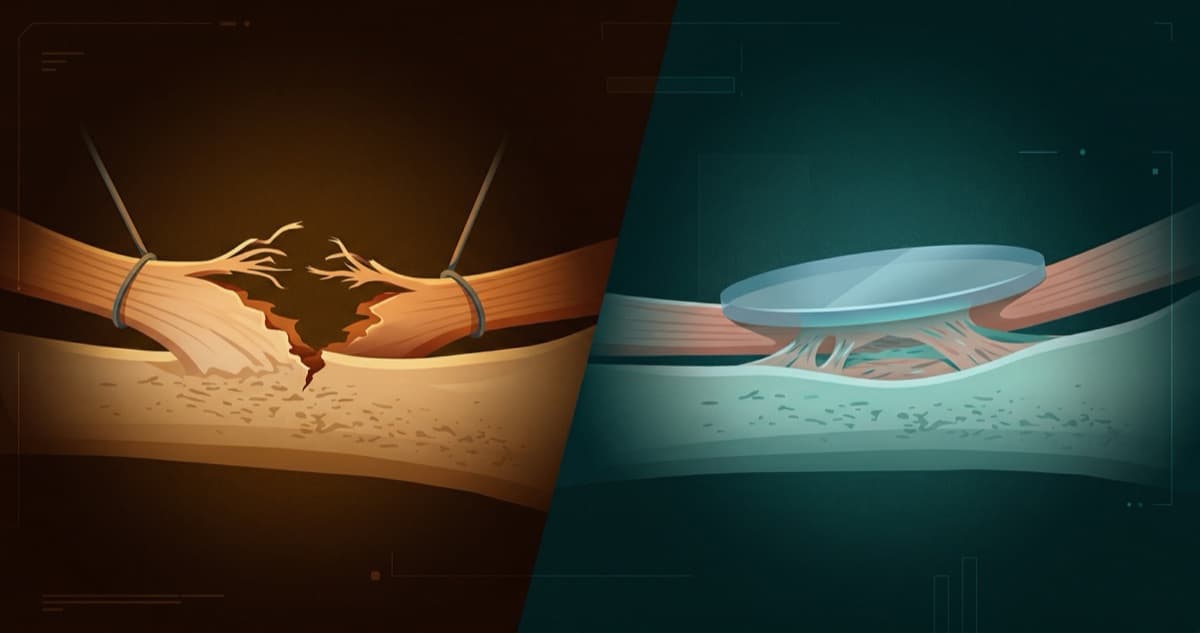
Why might compression promote fibrocartilage formation? In the 2023 paper, the team proposed a hypothesis: the PEEK button converts shear into compression, and compression guides cells toward cartilage rather than scar. Traditional sutures pull — tension drives cells toward fibrous tissue instead.
This isn't just intuition. Compress stem cells in a dish, and they start expressing cartilage genes. Compression alone works as well as adding TGF-beta directly5. Pull them instead, and they go the other way — expressing tendon markers and producing fibrous tissue7,8.
The Thomopoulos lab ran the most direct comparison: same cell population, compression versus tension. Tension produced elongated tendon-like cells. Compression produced rounded pre-chondrocytes9. Full chondrogenic differentiation also required TGF-beta3 — but in a surgical environment, TGF-beta is naturally released by wound healing.
More critically, the enthesis development literature shows that removing muscle load impairs fibrocartilage and mineralized zone formation entirely10. Enthesis fibrocartilage cells arise from mechanosensitive progenitors whose fate depends on the loading environment11.
The takeaway: it's not about which cells you inject. It's about what mechanical environment you provide.
What We Know and What We Don't
The evidence points in one direction, but several questions remain genuinely open.
The goat infraspinatus model doesn't perfectly replicate human supraspinatus biomechanics. Whether these results translate to human tissue requires clinical trials.
Compression and fibrocartilage appeared together, but PEEK surface properties and improved fixation stability could also contribute. Compression is the most parsimonious explanation, but it hasn't been fully isolated.
One in vitro study found that early compression (Day 1) actually suppressed chondrogenesis, while late compression (Day 21) enhanced it12. WingHeal applies compression from day zero — in vivo conditions are far more complex than a culture dish, but this is a question worth tracking.
Give Bone a Wing
Years ago, a senior orthopedic researcher reviewing this concept said: "The most advanced biological approaches can't reliably produce fibrocartilage. A simple washer can't possibly do it."
That objection was perfectly reasonable — if your assumption is that enthesis regeneration requires delivering cells directly. But from first principles, the question changes: not "can I make cells produce enthesis?" but "can I create the mechanical conditions for enthesis to regenerate naturally?"
Stem cell approaches try to bypass the mechanical environment. WingHeal tries to fix it and let the body's own cells decide what to become.
The animal data suggests the latter is at least worth taking seriously.
Further reading: Why Bone Needs a Wing — WingHeal Implant Design Philosophy | WingHeal Product Page
References
- Taha ME et al. A biomechanical comparison of different suture materials. J Orthop Surg Res. 2020. PMID: 31727418
- Borbas P et al. High-strength suture tapes are biomechanically stronger than sutures. Knee Surg Sports Traumatol Arthrosc. 2021. PMID: 34195657
- Ruiz Iban MA et al. Augmentation with a bioinductive collagen implant decreases the retear rate at 1 year. Arthroscopy. 2024. PMID: 38158165
- Lin CW et al. Global compressive loading from an ultra-thin PEEK button augment enhances fibrocartilage regeneration. Bioengineering. 2023. PMID: 37237635
- Huang CY et al. Effects of cyclic compressive loading on chondrogenesis of rabbit BM-MSCs. Stem Cells. 2004. PMID: 15153608
- Pattappa G et al. Cells under pressure — hydrostatic pressure and MSC chondrogenesis. Eur Cell Mater. 2019. PMID: 31056740
- Connelly JT et al. Tensile loading modulates BMSC differentiation and engineered fibrocartilage. Tissue Eng Part A. 2010. PMID: 20088686
- Qiu Y et al. Cyclic tension promotes fibroblastic differentiation of MSCs. J Tissue Eng Regen Med. 2016. PMID: 24515660
- Thomopoulos S et al. Fibrocartilage tissue engineering: the role of the stress environment. Tissue Eng Part A. 2011. PMID: 21091338
- Thomopoulos S et al. The development and morphogenesis of the tendon-to-bone insertion. J Musculoskelet Neuronal Interact. 2010. PMID: 20190378
- Schwartz AG et al. Enthesis fibrocartilage cells from Hedgehog-responsive cells modulated by loading. Development. 2015. PMID: 25516975
- Liu Y et al. Effects of mechanical compression on chondrogenesis of human synovium-derived MSCs. Front Bioeng Biotechnol. 2021. PMC: 8327094
- Park YE et al. Knot impingement after rotator cuff repair: is it real? Arthroscopy. 2014. PMID: 24908257