The Invisible Failure Window
A patient returns six weeks after rotator cuff repair. The ultrasound looks clean. The patient reports feeling "okay, a bit tight." The surgeon schedules the next follow-up in three months.
During those three months, nobody knows how much force the repair site endures each day. Nobody knows whether an inadvertent movement has already started loosening the tendon. By the time the next imaging study reveals a structural gap, it is often too late — re-tear has already occurred.
This is the fundamental blind spot of post-surgical orthopedic monitoring: intermittent, passive, and late. We look only during scheduled visits, we see only what has already happened, and we cannot see what is happening right now.
Research data reinforces this point. A clinical study of 130 total knee arthroplasty patients found that embedded sensor data achieved 95-97% compliance rates — far exceeding patient-reported outcome questionnaire compliance[1]. More critically, the study revealed only weak correlations between what patients reported feeling and their actual gait kinematics — "feeling okay" does not mean the knee is actually functioning well. Objective, continuous data is simply more reliable than intermittent, subjective reports.
A Sensor Without a Battery
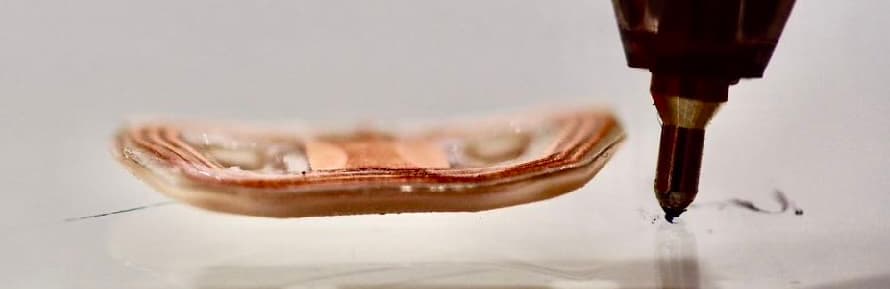
Discovery R is an implantable pressure sensor designed specifically for post-surgical orthopedic monitoring. At its core is something deceptively simple: an LC resonant circuit.
L stands for inductor, C for capacitor. Together, they form a circuit with a physical property: it resonates at a specific frequency. When external pressure changes, the capacitor's geometry shifts slightly, and the resonant frequency shifts with it.
An external reader (a coil) uses electromagnetic coupling to scan for this frequency shift, converting it into a corresponding pressure value.
In rotator cuff repair, suture tension is converted into pressure by the WingHeal PEEK augment. By detecting pressure changes, the sensor can infer suture tension changes — is the suture loosening?
The entire process requires no battery. The sensor is purely passive — it does not transmit signals, store data, or need charging. Energy comes from the external reader's electromagnetic field.
Why "battery-free" matters.
Consider the only commercially available smart joint implant (used in total knee arthroplasty): it requires an internal battery and complex electronic circuitry, resulting in large form factor, high cost, and applicability limited to specific large joints. Batteries have finite lifespans. Electronic components also carry encapsulation failure risk (current manufacturers require one more encapsulation layer than cardiac pacemakers). Most electronic materials are not biocompatible and require high-density packaging for isolation.
Discovery R's passive design sidesteps all of these problems. No battery means no lifespan limitation. No complex circuits means no encapsulation risk. The form factor can be made extremely small — small enough to integrate directly into existing orthopedic implants without changing the surgical workflow.
Materials and Durability
Every layer of Discovery R has been validated for biocompatibility:
- Gold conductors: Excellent conductivity and corrosion resistance
- PDMS encapsulation: Elastic, waterproof, tissue-compatible
- PEEK substrate: Directly integrated with the WingHeal implant family
A single-layer MEMS process creates a dual-layer sensing structure — simple manufacturing that scales and controls cost. An innovative capacitor design reduces eddy current losses — traditional LC sensors suffer from magnetic eddy currents between the electrode plates and the inductor, degrading sensing range. Discovery R's design solves this, extending effective reading distance.
Durability testing results: 180 days of continuous implantation plus 2,000 repeated compression cycles with no degradation in sensing quality or structural stability.
Traffic Light Rehabilitation
With real-time pressure data, the logic of rehabilitation changes completely.
Discovery R's clinical vision is a traffic light feedback system. An external reader (potentially a wearable wristband) scans the sensor before and after each rehabilitation movement, outputting one of three signals based on pressure changes:
- Green: Forces within safe range — continue
- Yellow: Approaching warning threshold — pause and notify care team
- Red: Entering hazard zone — stop immediately and contact physician
Combined with IMU (inertial measurement unit) motion data, the system can build a pressure-to-movement correlation model — knowing not just "how much force" but "which movement caused it." This enables rehabilitation therapists to design more precise, personalized recovery programs.
A clinical study of 258 patients further validates this direction: gait data collected at 6 weeks post-surgery strongly predicts 12-week recovery outcomes (correlation r = 0.87-0.92)[2]. Even more compelling, in a presentation at AAOS 2026, the research team reported that when a patient's gait metrics deviate from the expected "recovery curve," this deviation correlates with higher risk of venous thromboembolism (VTE) and periprosthetic joint infection (PJI)[2]. Continuous sensor data is not just tracking recovery — it may serve as an early warning system for complications.
Discovery R measures forces directly at the tissue interface, not surface-level gait kinematics — meaning it has the potential to detect inflammation, fluid accumulation, or mechanical loosening before gait changes even appear.
From "one imaging check every three months" to "real-time monitoring during every rehabilitation session" — this is a fundamental paradigm shift.
Why Not Just Use a Smart Joint?
Current commercial smart implants (such as those for total knee arthroplasty) focus on motion data (acceleration, angular velocity) as monitoring aids, but they rely on indirect data to infer implant status. The approach works — clinical data shows smart knee implants achieve a 1-year revision rate of just 0.3%, compared to 1.0% for traditional implants[3]. But they require large batteries, complex circuits, and high-density packaging — size and cost constraints that limit their application to arthroplasty procedures.
The soft tissue repair surgeries with the highest failure risk and greatest need for post-surgical monitoring — rotator cuff repair, ACL reconstruction — represent a complete market gap. Discovery R's passive, miniaturized, low-cost design exists specifically to fill it.
What Comes Next
Discovery R is planned for FDA De Novo classification. In 2021, the world's first smart knee implant received FDA clearance through the De Novo pathway, establishing a regulatory precedent for the smart implant category[4]. Discovery R's passive LC sensor architecture is technically novel, but the regulatory pathway now has a reference point.
Development is a joint effort between De Novo Orthopedics and Taiwan's Metal Industries Research & Development Centre. Future directions include combining electromagnetic stimulation to promote local blood circulation, extending the device from "sensing" to "treatment" — creating an integrated sensing-and-therapeutic orthopedic solution.
For more product information, visit the development pipeline.
References
-
Yocum DE, et al. Patient-Reported Outcomes Do Not Correlate to Functional Knee Recovery and Range of Motion After Total Knee Arthroplasty. J Orthop Case Rep. 2023;13(08):3844. PubMed
-
Cushner FD, et al. Staying Ahead of the Curve: The Case for Recovery Curves in Total Knee Arthroplasty. J Arthroplasty. 2025;40(2):431-436. PubMed
-
Gordon MJ, et al. Smart Knee Implants and Functional Outcome for Total Knee Arthroplasty. J Knee Surg. 2025. PubMed
-
Iyengar KP, et al. Smart Sensor Implant Technology in Total Knee Arthroplasty. J Clin Orthop Trauma. 2021;23:101605. PubMed